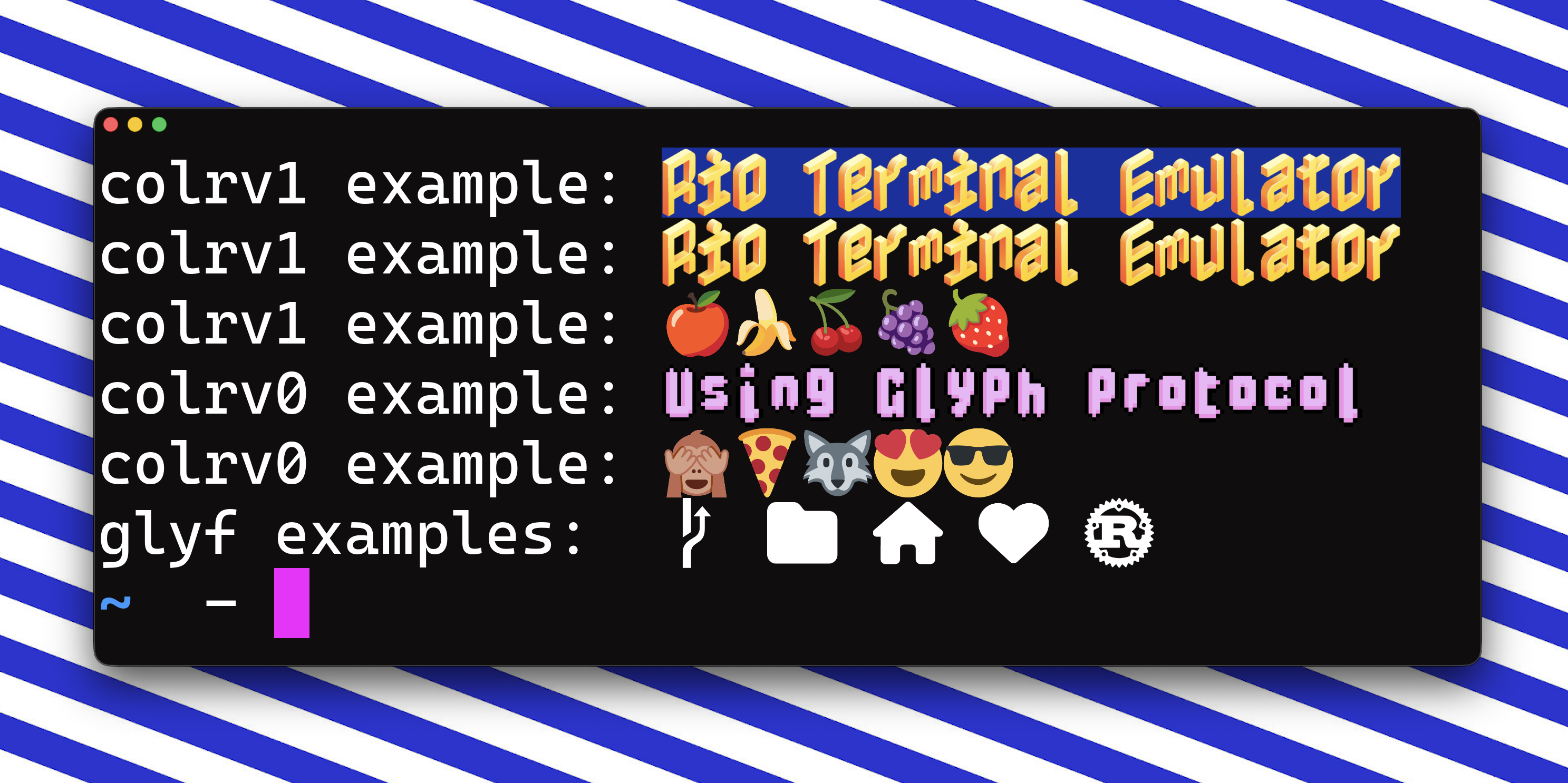
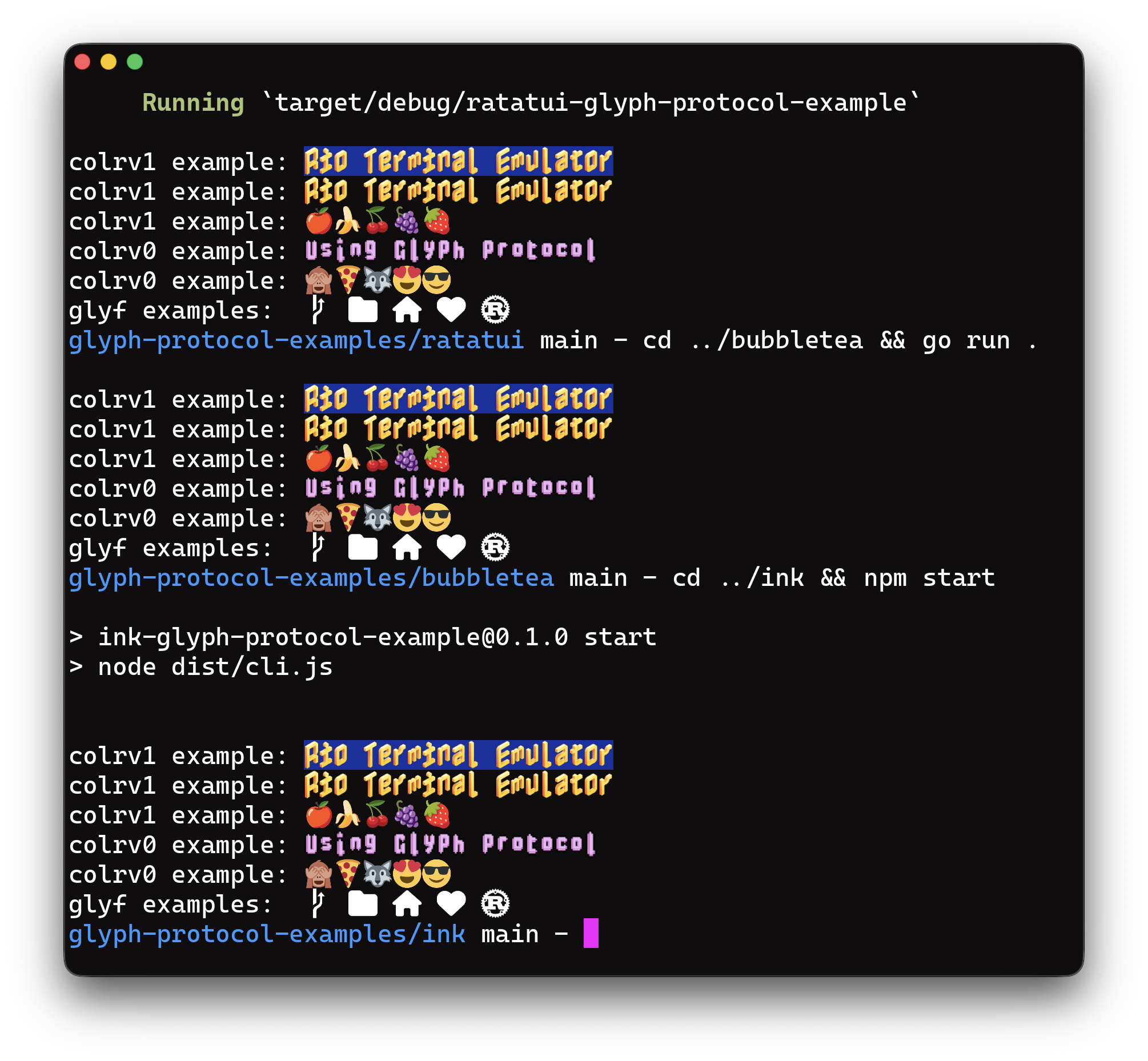
A few days after introducing Glyph Protocol, the first serious feature landed: colour.
The initial protocol only had one payload format, fmt=glyf: a single OpenType simple-glyph outline, rendered in the current foreground colour. Good enough for Nerd-Font-style monochrome icons (e.g: U+E0A0 git branch, U+F015 home) or even symbols. But the whole class of modern iconography (a red heart, a green status dot, a multi-color brand logo) was out of reach.
Two formats, not one
Colour glyphs exist in a well-travelled design space. OpenType already has it, in two ways:
colrv0is the simple one: a base glyph references a list of layer glyphs and per-layer palette indices. Each layer is a flat colour. Layers composite front-to-back. No transforms, no gradients, no blend modes. Powers most Windows 10 emoji and is about ten years old at this point.colrv1is the ambitious one: a full paint graph. Nodes are linear, radial, and sweep gradients; affine transforms; composite modes; layer groups; references to other glyphs. Powers the Google Noto emoji and Chrome’scolrv1implementation.
The natural question: should Glyph Protocol add both, or just one?
Both. They don’t compete; they’re tiered. A terminal that only implements the simple case gets a useful subset of colour. A terminal that goes all-in gets Apple-quality emoji. Applications advertise the format they’re shipping and the terminal advertises what it supports; the two negotiate without a round-trip per glyph.
Reuse, don’t reinvent
The observation is the same one that motivated using glyf for monochrome in the first place: every terminal that renders OpenType already has a parser for this.
For example: ttf-parser’s colr::Table::parse(cpal, colr) accepts a standalone COLR + CPAL blob with no surrounding font context required. skrifa (the parser behind Chrome’s colrv1 renderer) does the same. Both walk colrv0 and colrv1 through a shared Painter/ColorPainter callback trait. Outside Rust the same job is one library call away: HarfBuzz walks colrv0 and colrv1 through hb_paint_funcs_t and is already linked into every Pango/GTK-based terminal; FreeType handles both in C and is the default text-shaping dependency on basically every Linux distribution; Skia ships the colrv1 renderer Chrome itself uses; fontTools covers Python; and Apple’s CoreText and Microsoft’s DirectWrite handle it natively at the OS level. Adopting OpenType binary means the protocol gets a paint-graph parser and walker for free, in every mainstream language.
The catch: a COLR table is useless on its own. It only contains layer and colour references. The actual glyph outlines live in the font’s glyf table, addressed by GlyphId. Our protocol ships one glyph at a time, not a full font, so Glyph Protocol wraps the COLR + CPAL tables in a tiny container that also carries the outlines each layer references:
u16     n_glyphs
repeat n_glyphs:
  u16   glyf_len
  glyf_len bytes              # simple-glyph, same subset as fmt=glyf
u16     colr_len              # OpenType COLR table (colrv0 or colrv1)
colr_len bytes
u16     cpal_len              # OpenType CPAL table (may be 0 for colrv1)
cpal_len bytes
GlyphId values in the COLR table index into the outline array. paletteIndex values in layer records index into the CPAL colour records. paletteIndex = 0xFFFF means “use the current foreground colour”, per the OpenType spec. That’s the whole contract. The rest is COLR’s job.
The container adds 16 bytes of length-field overhead for a five-layer icon, plus ~70 bytes of fixed COLR + CPAL headers. Negligible compared to the outline data itself.
Registering a colour glyph
Same r verb as before, but the fmt parameter selects the payload format:
ESC _ 25a1 ; r ; cp=E0A0 ; fmt=colrv0 ; upm=1000 ; <base64-container> ESC \
Everything else is unchanged. One codepoint consumes one slot regardless of payload: a fmt=colrv1 registration carrying 500 inner outlines still eats exactly one slot.
What’s intentionally left out
- No sfbx/sbix/CBDT bitmap tables. Those are raster. Terminal cell sizes vary wildly (12 px in tmux on a laptop, 32 px on a HiDPI desktop) and a bitmap optimised for one size is wrong at the other. Every format Glyph Protocol accepts is vector.
Future work
- Finer-grained registration scope. Optional flags to share a glyph across all PTYs at once (so a system-wide icon registry survives tmux splits and reattaches), or pin one as un-evictable for the life of the session. Both go beyond the current per-session, FIFO-eviction defaults.
- Shared colour palettes. Every
colrv0/colrv1registration currently ships its own CPAL inline. A way to upload a palette once and let subsequent glyph registrations reference it by ID would save thousands of redundant bytes for emoji families (Twemoji, Noto, Fluent) where every glyph reuses the same ~50-entry palette. - Animation. I’d like to explore Lottie as a future payload format for motion.
Authoring colour payloads
Most applications will not hand-craft COLR tables. Two tools make the pipeline straightforward:
nanoemoji: Google’s SVG →colrv1compiler, originally built for Noto emoji. Feed it a directory of SVGs, get a.ttfback. Slice theCOLR,CPAL, and referencedglyfoutlines out of that TTF withfontTools, pack them into Glyph Protocol’s container, and register.fontTools: for pulling COLR data out of existing colour fonts (Noto Color Emoji, Fluent Emoji, Twemoji-via-COLR).
Other pipelines work too. Anything that can emit a COLR + CPAL pair and the underlying outlines can produce a valid payload.
Status
The wire format, parser, registry storage, and support advertisement will land somewhere in May.
And if you’re implementing Glyph Protocol in a different terminal, adding colour support now is mostly linker work: pull ttf-parser, skrifa, or any COLR parser. Feel free to reach out if you are.
–
The more general principle: a terminal protocol doesn’t have to invent a new binary format to ship new features. Colour glyphs, emoji, icons: the graphics community worked through the hard questions a decade ago. We just ride the bus.